AK-47 Tequila Bottle: The Ultimate Collector's Guide (2026)
Updated for 2026: Product availability, pricing, demand, materials, intellectual-property status, and local marketing rules vary by product and market. Buyers should verify current evidence for the exact concept and destination before ordering or making claims.
| Key takeaway | Why it matters for B2B buyers |
|---|---|
| AK-47 tequila bottle demand stays niche | Listings exist, but current sell-through and growth need to be validated for the intended market. |
| The bottle can sell the first look | Many buyers may treat it as shelf décor or a novelty gift, while liquid quality still affects repeat purchase. |
| Glass economics work only with sell-through | Unit cost can look attractive, but tooling, packing, freight, damage, and inventory time belong in the model. |
| The “quality signal” risk is real | Some shoppers may associate gun shapes with novelty rather than premium tequila. |
| Legal and safety review adds friction | Names, marks, weapon-like visuals, local marketing rules, and product presentation require review. |
| A mixed novelty portfolio can spread risk | Skull, dragon, agave, ship, globe, and original concepts can reach different buyers. |
AK-47 tequila bottle demand: real interest, market-specific upside
An AK-47 tequila bottle can sell in the novelty lane. The category appears in specialty retail and repeat listings, but those observations do not establish a universal demand trend. Buyers should validate current sell-through, repeat orders, return rates, and price tolerance in the intended market.
Importers can still win if they sell to the right channel. Bars, party retailers, and gift shops may move units. Private-label buyers should treat it as a niche SKU until current channel evidence supports a larger commitment.
Design research helps you avoid dead inventory. Start with a unique tequila decanter in an AK-47-style design concept and use existing products to understand the category—not to copy protected marks, trade dress, or a third party’s exact design.

Who buys gun-shaped bottles and where they may sell
Many buyers do not shop gun bottles like conventional premium tequila. They may shop them as conversation pieces, place them on a shelf, or give them at parties. Some buyers may never open them. That behavior changes the channels worth testing.
Possible channels include:
- Bars and night venues that want themed displays
- Gift and novelty stores with relevant foot traffic
- Specialty liquor shops that have validated local demand
Online demand exists, but weapon-like visuals can face platform, advertising, payment, or marketplace limits. Review the current written policies for every intended channel. A B2B-first plan can be one option, but it does not replace demand testing.
Product angle ideas live here: tequila bottle guns and novelty positioning and AK-47 whiskey glassware shelf appeal.
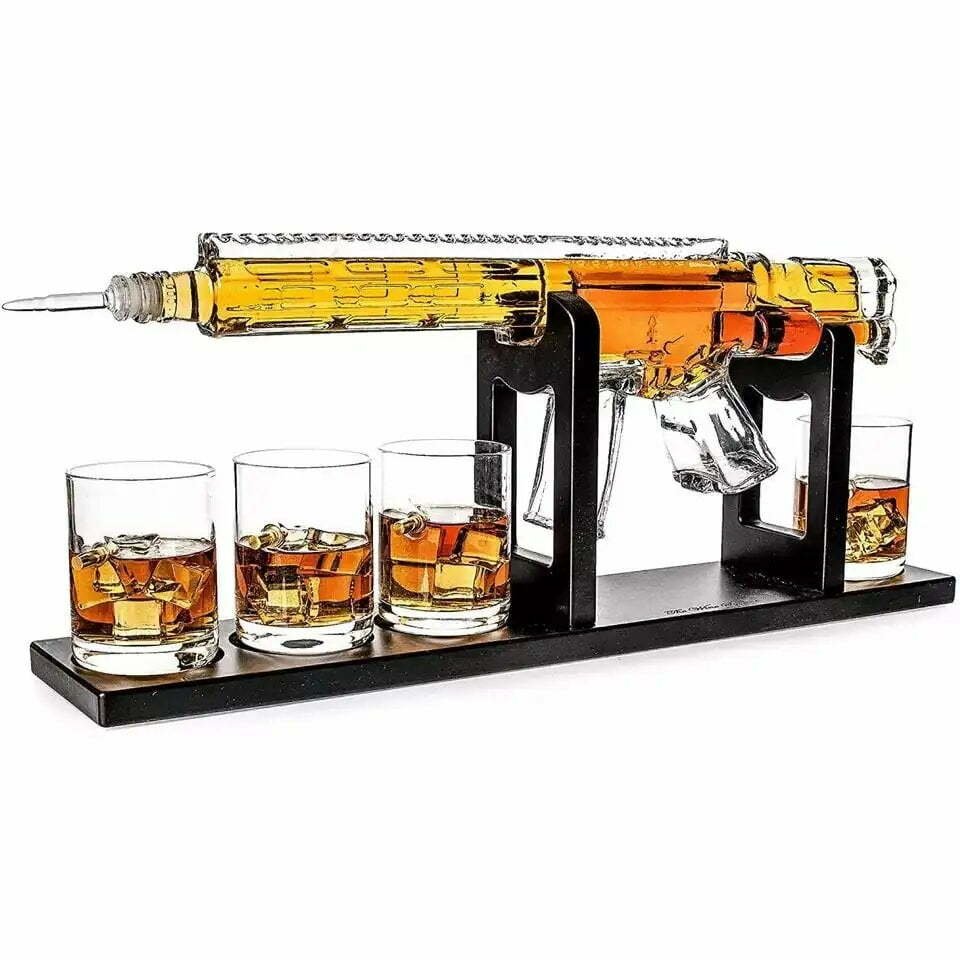
Retail pricing and importer margin math
Retail prices vary with the filled spirit, brand, capacity, material, decoration, packaging, taxes, and market. The bottle cost also changes with the approved specification and order assumptions. Build the margin case from current comparable listings, supplier quotations, and realistic sell-through; slow-moving stock can erase an attractive unit margin.
A simple margin model helps:
- Bottle + closure + decoration: specification-dependent cost drivers
- Mold: a development cost that needs a realistic allocation
- Packing: a cost that protects the product and the order value
- Freight, damage, chargebacks, and returns: landed-cost items that should be modeled
Many buyers try to “save” money by using weak cartons. They may pay more later in breakage and claims. A stronger pack specification can raise landed cost, but the decision should be based on test results and total order risk.
For sourcing and OEM planning, use borosilicate whisky decanters OEM and OEM/ODM design to production.
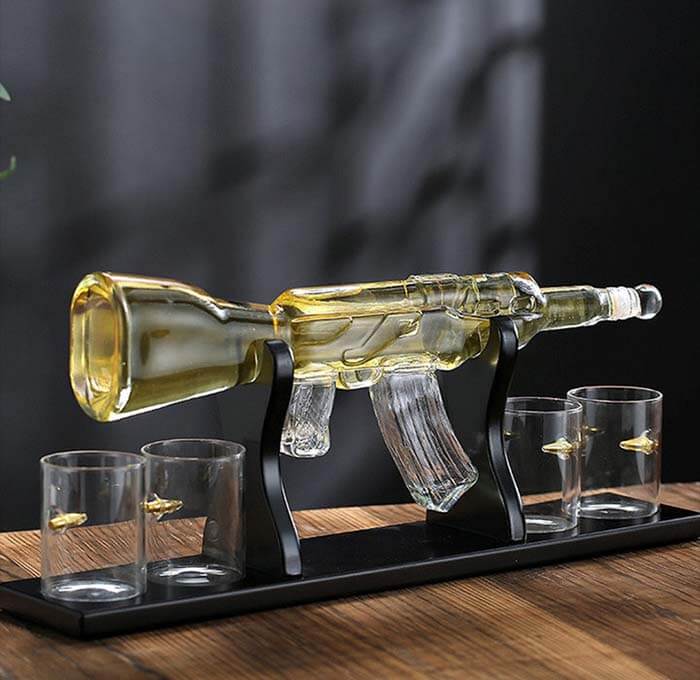
The “quality signal” problem and how to reduce it
Gun-shaped bottles can send different signals to different audiences. Some shoppers may assume that a dramatic novelty shape means lower liquid quality, which can hurt premium positioning. Test the concept with the intended buyer rather than treating that reaction as universal.
You can control the cues around the bottle:
- Use a clean label with accurate, legally reviewed product information
- Avoid cheap-looking prints and set limits for visible seams and defects
- Add a suitable closure and tamper-evident features
- Check balance and handling so the bottle feels deliberate rather than toy-like
The liquid still matters. A distinctive bottle can trigger a first sale; product quality and brand credibility help earn the second sale.
Helpful pages for brand framing: AK-47 tequila bottle flavors and reviews and additive-free tequila bottles.
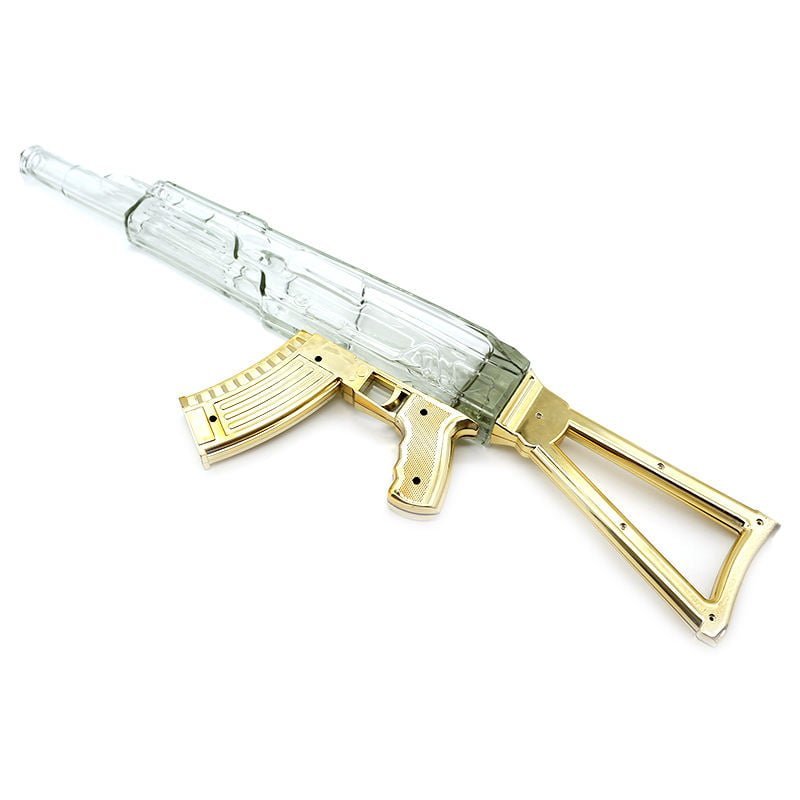
Shape engineering: neck finish, pour, and stability
A rifle shape creates design traps. Long “barrel” sections can chip in packing. Thin details can crack in handling. A weak neck finish can leak or create closure problems. Buyers notice these flaws quickly.
Focus on these build rules:
- Keep wall distribution controlled in long sections
- Simplify or reinforce vulnerable details where the selected forming process allows
- Use a documented thread and neck finish for the closure
- Keep a stable base and check the filled-product center of gravity
Prototype testing can prevent expensive changes later. A physical sample should be evaluated against agreed methods and pass criteria, which may include capacity, dimensions, pour, cap fit, leak, tilt, residual stress, decoration, and packaged-drop performance. The exact checks depend on the product and route.
For mold and prototype planning, use glass bottle molds and prototypes and unveiling the art of tequila bottle design.
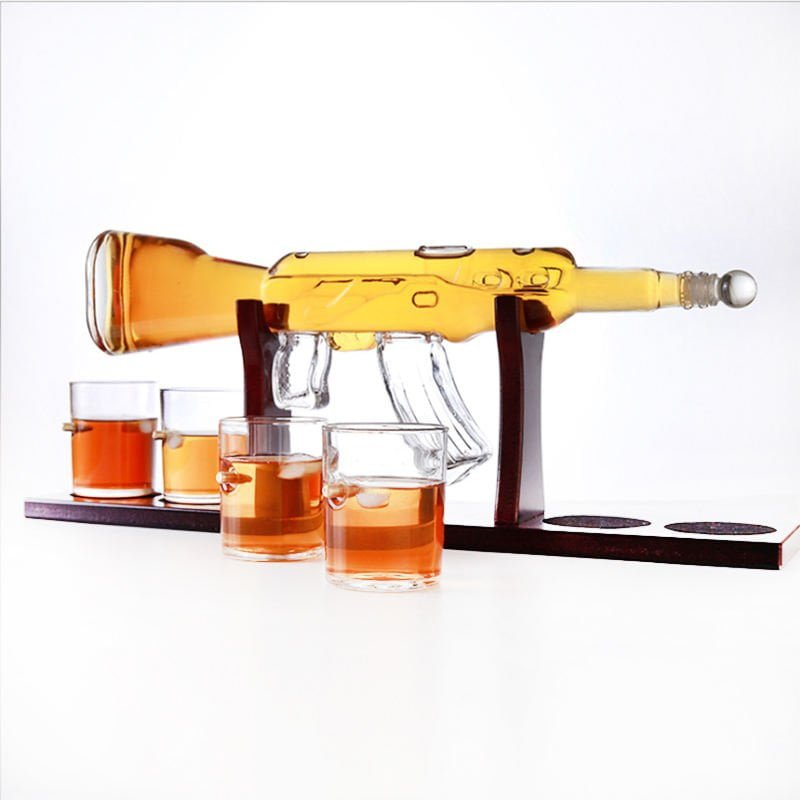
Borosilicate vs. soda-lime for a gun-shaped bottle
Both material families can be considered, but the practical choice depends on the glass grade, forming route, geometry, intended contents, compliance requirements, quality plan, and commercial assumptions. Soda-lime has a broad container-manufacturing base. Borosilicate is used in specialty tubing, lampworking, technical components, and selected hollowware. Neither material name alone proves clarity, durability, food-contact suitability, or a premium result.
Set the material specification with product-specific evidence:
- Glass grade and process: confirm what the supplier will actually use
- Finished-product performance: define dimensional, annealing, leak, closure, and packing checks
- Food-contact and restricted-substance evidence: cover the glass, colors, decoration, coatings, and closure for the target market
- Cost comparison: use the same drawing, QC plan, packing, and order assumptions
Use this borosilicate vs. soda-lime glass comparison to set the brief. Do not treat “lead-free” or “food safe” as a material-family guarantee; request evidence for the finished product and intended conditions.
Mold, MOQ, and the volume reality check
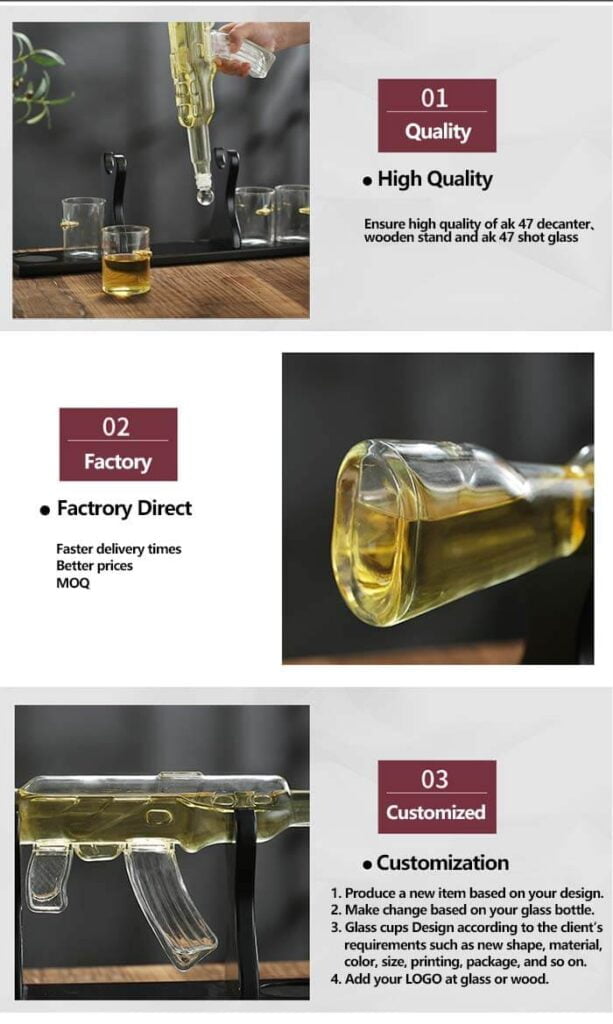
Mold cost can look small compared with a full order. The larger issue is whether the quoted MOQ and inventory exposure fit verified demand. MOQ, tooling, samples, yield, and production timing are project-specific and should be confirmed after design review.
A staged approach can reduce uncertainty:
- Check whether an existing lawful, unbranded shape fits the test objective
- Approve material, capacity, neck finish, decoration, QC, and packaging on representative samples
- Move to original tooling only when demand, rights review, and manufacturability support it
Mold ownership also matters. Document ownership or access rights, permitted use, storage, revision control, and end-of-relationship handling in writing. Use these pages to control the process: prototype custom bottle and custom shapes whisky decanters.
Decoration that sells: color, branding, and print choices
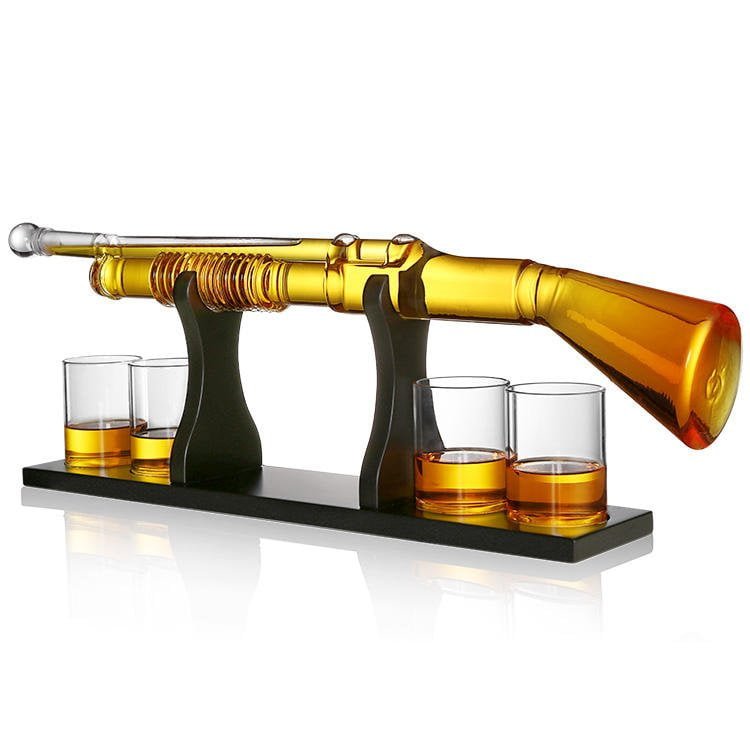
Decoration can lift perceived value, but it can also affect yield, durability, compliance, and timing. Clean branding can make the bottle look deliberate; poor print or inconsistent registration can make it look toy-like.
Possible decoration options include:
- Screen print for suitable bold marks
- Hot stamping for selected premium accents
- Decals for fine patterns and small text
- Colored glass or coatings where process and compliance allow
A gun silhouette is already visually strong. A clean label and restrained color system may work better than heavy graphics, but approve the direction with the target audience and on representative samples.
Use these guides to plan branding and color: borosilicate decanter branding options and the customized labels guide.
China sourcing: audits and factory checks
Gun-shaped bottles need reliable forming and stable QC. That pushes supplier capability and process control to the top of the risk list. A supplier should demonstrate repeatability for the actual design rather than rely on general claims.
Strong sourcing habits include:
- Ask for relevant export and inspection evidence
- Check mold management, maintenance, and sample control
- Confirm capacity and timing against the proposed process and order scenario
- Use third-party inspection when the project risk justifies it
A factory visit or remote audit can help reveal gaps when it follows a written checklist and is supported by records and tests. Peak seasons can affect molds, samples, decoration, and production, so timing needs current confirmation.
Useful sourcing pages: China borosilicate decanter suppliers, top glass manufacturing regions in China, and how to vet supplier production capabilities.

QC and packing: the fastest way to protect profit
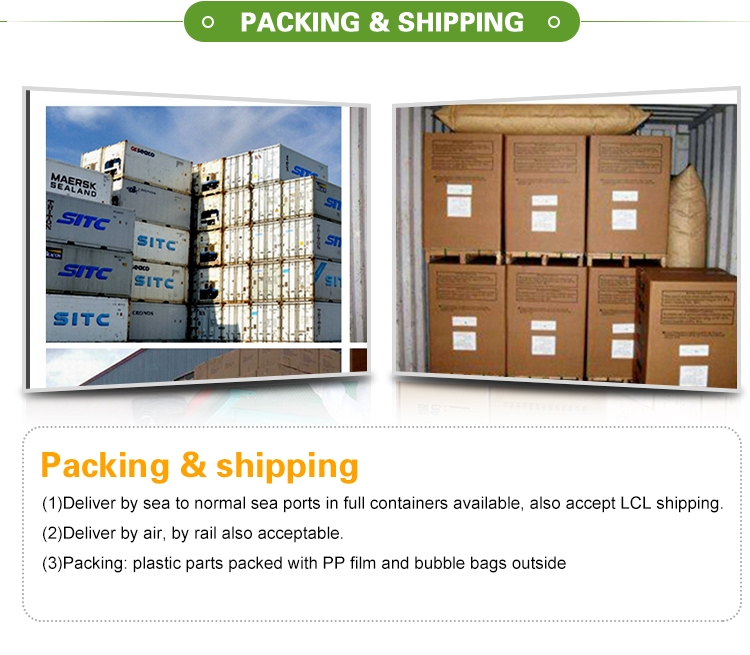
A gun shape has more exposed details than a standard round bottle. The “barrel,” “magazine,” and thin edges can chip. Better packing can reduce claims, but the pack should be validated for the actual product and shipping route.
Build a project-specific QC checklist:
- Check cracks, bubbles, stones, sharp seams, and agreed cosmetic limits
- Measure neck finish and closure fit
- Confirm capacity, dimensions, base stability, and relevant annealing controls
- Test cartons with the specified dividers, protection, pallet pattern, and agreed protocol
- Confirm label position, rub resistance, and print durability
Packing also supports the brand. A neat inner pack can feel premium and help distributors handle cases with less damage. Set methods, sampling levels, and pass/fail criteria before production rather than relying on a generic promise of “strict QC.”
Use these operational guides: OEM onboarding guide for glassware and custom lid types guide.
Legal and safety risk: higher friction than many novelty shapes
Gun shapes can carry additional risk. The “AK-47” name, third-party logos, model-specific details, artwork, product configuration, and overall presentation may raise trademark, copyright, design-right, trade-dress, advertising, import, platform, or local safety questions. The outcome depends on the exact design, jurisdiction, and use; this article is not legal advice.
A weapon-like bottle can also be misunderstood in some contexts. Evaluate whether its color, scale, handling, or presentation could create confusion, and review current rules for alcohol marketing, weapon-like products, youth appeal, carriers, retailers, and online platforms.
Risk controls can help:
- Do not assume that removing a logo makes a near-copy safe to manufacture or market
- Avoid third-party marks and model-specific features unless the necessary rights are confirmed
- Use legal counsel to review the proposed name, artwork, silhouette, and target markets before tooling and launch
- Consider clear brand cues and finishes that reduce realistic-weapon confusion
- Keep relevant approvals and rights representations in writing
Portfolio strategy: pair the concept with other novelty designs
A gun-shaped bottle can sit in a portfolio, but it does not need to carry the whole plan. Cultural, artistic, and original shapes may appeal to different audiences and may carry different production, legal, and platform constraints.
A mixed portfolio might include:
- Skull: strong shelf impact and a distinct cultural story
- Dragon: a fantasy-led collectible direction
- Agave-in-bottle: a clear tequila-related visual
- Ship or globe: gift and bar-display appeal
This mix can spread demand across more buyer types, but none of these shapes is automatically risk-free. Validate the design rights, manufacturability, channel fit, and unit economics for each one.
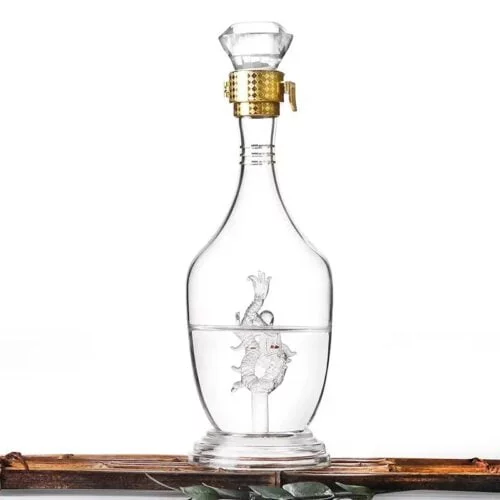
Examples include a tequila bottle with a skull aesthetic, dragon tequila bottle artistry, and tequila with an agave motif in the bottle.
Frequently asked questions
What MOQ makes an AK-47-style tequila bottle project safe?
No MOQ makes demand or compliance risk “safe.” The feasible MOQ depends on the design, process, tooling, decoration, supplier, and quality plan. Model the actual quoted scenarios and expected sell-through before committing.
Is borosilicate worth it for gun-shaped bottles?
Borosilicate may fit some specialty forming routes, while soda-lime may fit established container processes. Choose from the actual design, supplier capability, test requirements, compliance evidence, and commercial comparison—not from a generic premium claim.
How do you reduce the “cheap tequila” signal?
Test the concept with the intended audience, then control the glass finish, closure, label accuracy, decoration, balance, tamper evidence, carton, and filled-product quality.
Which decoration options work best on rifle shapes?
Screen printing, hot stamping, decals, colored glass, or coatings may be feasible depending on surface geometry, artwork, process, durability, compliance, and order assumptions. Approve the method on representative samples.
How do you plan sampling and mold changes?
Lock capacity, dimensions, neck finish, closure, material, decoration, QC methods, packaging, and the acceptance sample. Document mold rights, revision approval, re-sampling, and change control before production.
What should you check during a factory visit?
Check tooling control, annealing, inspection, decoration, sample control, capacity assumptions, packing, traceability, and corrective action. Support observations with records and product tests.
What packing specification reduces breakage?
The answer must be validated for the actual bottle and route. Define inner protection, clearance, dividers, carton strength, pallet pattern, and test conditions, then approve representative packed units.
What novelty shape is the closest alternative with less weapon-specific friction?
Skull, dragon, agave, ship, globe, or an original abstract concept may avoid some weapon-specific concerns, but every design still requires manufacturability, rights, market, and safety review.
